
Dropped Kerb Costs and Rules in Surrey: A Homeowner's Guide
If you want to park on your front garden, you will usually need a dropped kerb, and that comes with rules and costs worth knowing up front.
A dropped kerb is the lowered section of pavement kerb that lets a vehicle cross from the road onto your property. Without one, driving over the kerb is illegal and can damage the footpath. It can also invalidate your insurance if you have an accident turning onto your drive. Getting this right before any groundworks begin saves time, money, and a lot of frustration.
When you need a dropped kerb and who approves it
You need a dropped kerb whenever a vehicle needs to cross a public pavement to reach your property. This applies whether you are installing a new driveway on a front garden or widening an existing access point.
The kerb itself sits on the public highway, which means you cannot arrange it yourself. In Surrey, the highways authority responsible for most roads is Surrey County Council. They control the approval process and the physical installation work on the public road.
The process works like this. You apply to Surrey County Council for a vehicle crossover licence. They assess the application, check for obstructions such as lamp posts, gullies, or utility covers, and decide whether to approve it. If approved, the council arranges for the kerb to be lowered by their own contractors. You pay for this work.
The work on the private side of the boundary, meaning the driveway itself, is entirely separate. That is where a contractor like us comes in.
Planning permission is a related question many homeowners in Surrey ask at this stage. For most front driveways, you do not need planning permission, provided the surface drains correctly and the area is below a certain size. Our planning permission for driveways guide covers this in detail, so it is worth reading before you submit any application.
One thing to check early is whether your road is adopted or unadopted. Most residential streets in towns like Redhill, Reigate, and Banstead are adopted, meaning Surrey County Council maintains them. Unadopted roads follow different rules, and the process can vary. If you are unsure, your local council can confirm the status of your road.
Typical costs and what affects them in Surrey
Dropped kerb costs in Surrey come in two parts: the council fee and the driveway installation cost.
The council fee covers the assessment and the physical lowering of the kerb on the public highway. Surrey County Council sets these fees, and they change periodically, so we do not quote a fixed figure here. As a general guide, homeowners across Surrey typically pay several hundred pounds for the council portion alone. The exact amount depends on the number of kerb units involved and the complexity of the work at the road edge.
Several factors affect what you pay overall.
The width of the access point. A wider crossover requires more kerb units to be replaced, which increases the council charge. Most standard residential crossovers are between three and five metres wide.
Obstructions near the kerb. If there is a lamp post, a drainage gully, or a utility cover close to your proposed access point, the work becomes more complex. In some cases, these obstructions make a crossover impractical at that location.
The condition of the footpath. If the pavement near your property is in poor condition, the council may require additional reinstatement work as part of the crossover. This adds to the overall cost.
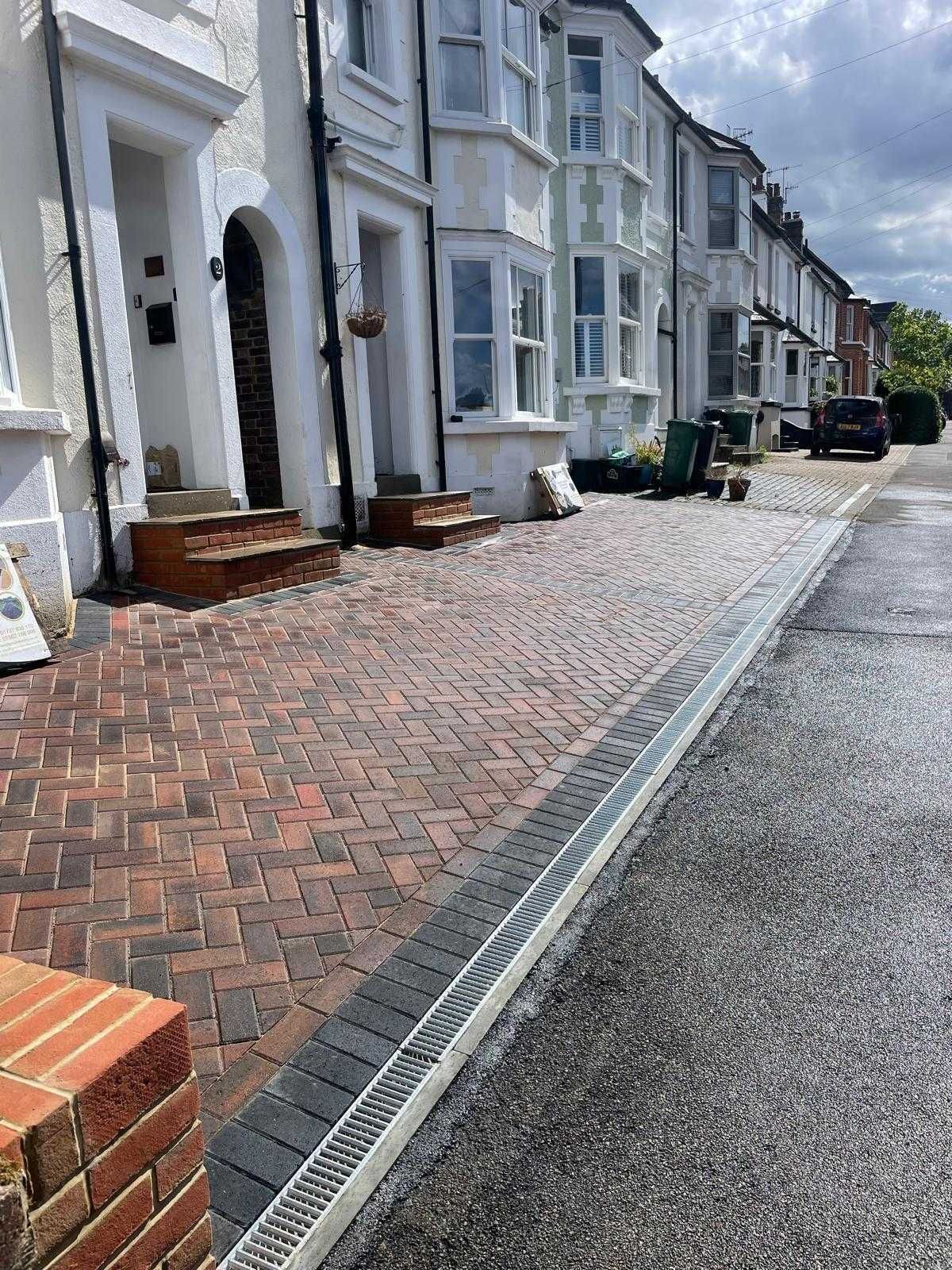
The driveway itself. The kerb is only the start. Once access is approved and the kerb is in place, you still need the driveway surface installed on your property. This is the larger part of the overall project, and the cost depends on the size of the area, the material chosen, and any groundworks or drainage required.
We have installed
driveways across Surrey for over 20 years, and we give every homeowner a fixed price before work starts. No surprises when the invoice arrives.
How a dropped kerb fits into a full driveway project
Most homeowners approach us when they are planning the whole project, not just the kerb. That is the right way to think about it. The dropped kerb and the driveway are connected, and planning them together avoids problems later.
Here is how a typical project runs in Surrey.
First, confirm the access point. Before committing to a driveway design, check that a dropped kerb is achievable at your chosen location. We can advise on this during a site visit. There is no point designing a driveway around an access point that the council will not approve.
Then apply to Surrey County Council. The application process takes time. Surrey County Council aims to process straightforward applications within a reasonable timeframe, but it is sensible to allow several weeks. Starting the application early means your driveway installation is not delayed once the kerb is in place.
Then plan the driveway. While the application is being processed, we can finalise the driveway design, agree the price, and schedule the installation. By the time the kerb is lowered, everything on the private side is ready to go.
Finally, the installation.
Our own team carries out all the groundworks, drainage, and surfacing. We do not use subcontractors. Every job is done by the same people who quoted it, which means no miscommunication and no handover problems.
Homeowners in
Tadworth,
Dorking, and across the wider Surrey area go through this same process. The council steps are consistent, and the driveway work follows once access is confirmed.
One last point. If you are in an area with a residents' parking scheme or a conservation zone, there may be additional considerations. We can flag these during a site visit so nothing catches you off guard.
Getting a dropped kerb approved and a new driveway installed is straightforward when you know the process. The key is starting in the right order and working with a team that has done it many times before.
To get a free, no-obligation quote for your driveway project, visit our
contact page or call
01737 936037.